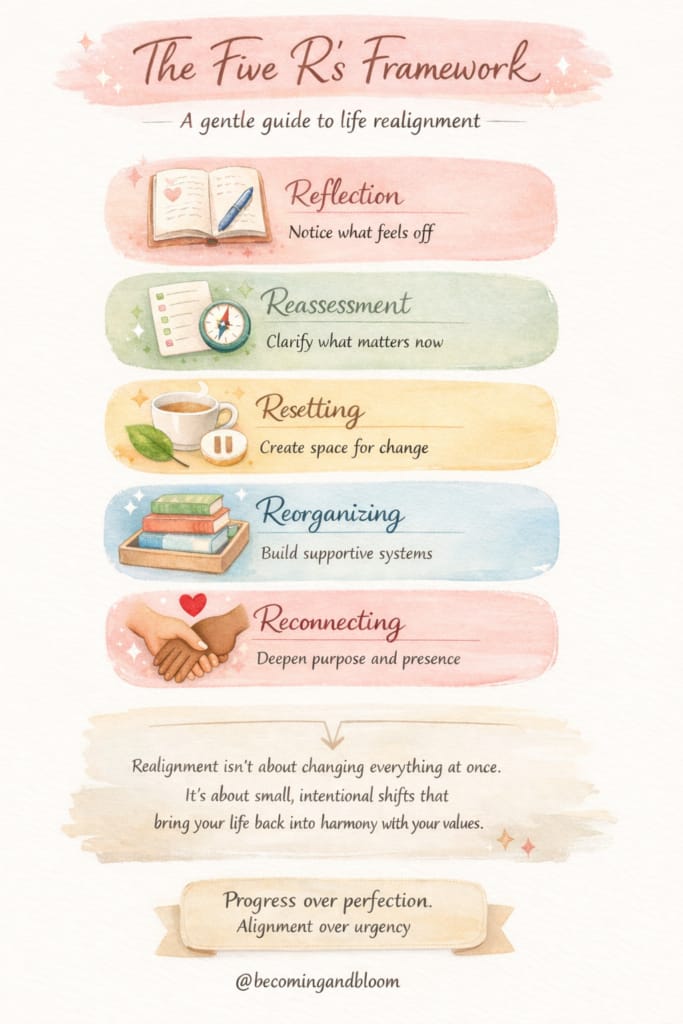
The Five R’s Framework: A Gentle Guide to Life Realignment

In This Article
- Understanding the Life Realignment Process
- Phase One: Reflection: The Art of Honest Self-Assessment
- Phase Two: Reassessment: Clarifying Your Path Forward
- Phase Three: Resetting: Creating Space for New Patterns
- Phase Four: Reorganizing: Building New Supportive Systems
- Phase Five: Reconnecting: Deepening Authentic Engagement
- Implementing the Five R’s: Seasonal Approach for Sustainable Change
- Your Journey Forward: Embracing Purposeful Progress
You know that unsettled feeling when your life seems slightly off-course? When your daily routines and choices don’t quite align with what truly matters to you? It’s like wearing clothes that once fit perfectly but now feel uncomfortable in subtle ways. This disconnect can manifest as restlessness, fatigue, or a persistent sense that something needs to change… but the thought of a complete life overhaul feels overwhelming.
This is where the Five R’s Framework comes in: a gentle, structured approach to intentional life realignment that honors both your desire for meaningful change and your need for manageable steps. Based on principles of positive psychology and mindful living, this framework provides a compassionate roadmap for bringing your life back into harmony with your core values, one thoughtful phase at a time.
Let’s explore how this five-part process (Reflection, Reassessment, Resetting, Reorganizing, and Reconnecting) can guide you toward a more aligned, purposeful life without the burnout that often accompanies major life transformations.
Understanding the Life Realignment Process

Before diving into each phase of the Five R’s Framework, it’s important to understand what makes this approach different from typical self-improvement methods. Traditional personal development often focuses solely on adding new habits or setting ambitious goals without addressing the underlying misalignments in your life.
In contrast, life realignment is about creating coherence between your daily choices and your core values. According to positive psychology research, this alignment is fundamental to authentic wellbeing. The PERMA+ model, developed by Dr. Martin Seligman, identifies essential elements of flourishing that include positive emotions, engagement, relationships, meaning, and accomplishment… all supported by health and mindset. This evidence-based approach validates the importance of intentional life evaluation and adjustment.
What makes the Five R’s Framework particularly effective is its gentle, cyclical nature. Rather than demanding dramatic overnight changes, it guides you through progressive phases of awareness and adjustment. This honors the natural rhythm of transformation and reduces the resistance that often sabotages our best intentions.
The Foundations of Effective Life Realignment
Effective life realignment isn’t about perfection… it’s about progress and authenticity. Research shows that structured frameworks with manageable phases reduce overwhelm and increase long-term adherence. When you approach change as a thoughtful process rather than a dramatic event, you create space for sustainable transformation.
The Five R’s Framework incorporates several key principles:
- Mindful awareness throughout each phase, enhancing your capacity for honest self-assessment
- Value-based decision making that prioritizes what truly matters to you
- Seasonal implementation that works with natural life rhythms rather than against them
- Progressive adaptation rather than abrupt, unsustainable changes
- Holistic perspective considering all dimensions of wellbeing
With these foundations in mind, let’s explore each of the Five R’s in detail.
Phase One: Reflection: The Art of Honest Self-Assessment
Every meaningful change begins with awareness. The Reflection phase creates space for thoughtful evaluation of your current life circumstances, patterns, and feelings without judgment or immediate pressure to act. This intentional pause allows you to notice subtle disconnects between your lived experience and your deeper values.
Reflection isn’t about harsh criticism or dwelling on perceived failures. Instead, it’s about compassionate curiosity and genuine inquiry into what’s working in your life and what feels misaligned.
Practical Reflection Techniques
To engage meaningfully with the Reflection phase:
- Daily journaling: Set aside 10-15 minutes each morning or evening to record observations about your energy, emotions, and experiences. Notice patterns without analyzing them immediately.
- Mindful check-ins: Throughout your day, pause briefly to notice how you feel physically, emotionally, and mentally during different activities. These micro-moments of awareness provide valuable insights.
- Values clarification: Revisit what matters most to you. Create a simple list of your core values (e.g., connection, creativity, growth) and reflect on how present these are in your daily life.
- Physical environment scan: Your space often reflects your internal state. Notice areas of your home or workspace that feel energizing or draining.
According to research from positive psychology experts, regular reflection enhances self-awareness and emotional regulation, creating a foundation for more effective life realignment. This phase isn’t about immediate solutions but about creating the awareness necessary for meaningful change.
“The journey of a thousand miles begins with a single step, but that step must be taken in the right direction. Reflection helps you determine that direction.”
Phase Two: Reassessment: Clarifying Your Path Forward

Once you’ve gathered insights through reflection, the Reassessment phase helps you evaluate what needs to change and why. This is where you begin transforming awareness into intention by clarifying your priorities and identifying specific areas for realignment.
Reassessment differs from reflection in its analytical focus: you’re now looking for patterns and making connections between your observations and potential paths forward. This phase helps you distinguish between temporary discomforts and genuine misalignments that require attention.
Structured Reassessment Approaches
To make your reassessment phase productive:
- Life domain evaluation: Assess key areas of your life (relationships, work, health, home, finances, personal growth) on a scale of 1-10 for both satisfaction and alignment with your values. Look for discrepancies and patterns.
- Energy mapping: Track which activities, people, and environments energize you versus which ones consistently drain you. This reveals natural pathways for realignment.
- Future self visualization: Imagine your ideal life one year from now if alignment were restored. What’s different? What remains the same? This creates clarity about desired changes.
- Decision filter creation: Develop simple questions to guide future choices, such as “Does this bring me closer to or further from alignment with my core values?”
Cultural and demographic research indicates that reassessment practices benefit from personal tailoring: what works for one person may not work for another. Honor your unique context and adjust these approaches to fit your circumstances and cultural background.
“Reassessment isn’t about judgment but about clarity. It’s the bridge between awareness and action.”
Phase Three: Resetting: Creating Space for New Patterns
The Resetting phase is about intentional release and boundary-setting. Before new patterns can take root, you need to create space by letting go of what no longer serves you and establishing limits that protect your realignment process.
Resetting might involve temporarily stepping back from certain commitments, relationships, or habits to create the mental and emotional bandwidth needed for meaningful change. This isn’t about permanent elimination but about creating breathing room for your realignment to unfold.

Effective Resetting Strategies
To implement a thoughtful reset:
- Digital boundaries: Designate specific times to disconnect from devices, social media, or email to reduce information overwhelm and reactive behavior patterns.
- Schedule simplification: Identify non-essential commitments you can pause or reduce during your realignment period. This might mean saying no to new projects or scaling back social obligations.
- Physical decluttering: Clear spaces that feel chaotic or draining. Even small areas of order can create a sense of possibility and control.
- Habit interruption: Identify one or two automatic habits that reinforce misalignment (e.g., reflexively checking email first thing in the morning) and consciously pause them for a defined period.
- Communication planning: Prepare simple, clear ways to communicate your boundaries to others without extensive explanation or apology.
Resetting tip: Behavioral research demonstrates that temporary pauses or “pattern interrupts” create cognitive space for new choices. By consciously resetting certain aspects of your life, you reduce the automatic continuation of misaligned patterns.
“Sometimes the most productive thing you can do is create space: space to breathe, space to think, space to realign.”
Phase Four: Reorganizing: Building New Supportive Systems
Once you’ve created space through resetting, the Reorganizing phase focuses on establishing new structures and routines that support your desired alignment. This is where intentional design replaces reactive patterns, allowing your daily life to naturally reinforce your core values.
Reorganizing is both practical and psychological… you’re creating external systems and internal mindsets that work together. This phase transforms insights into tangible changes that gradually become your new normal.
Sustainable Reorganization Approaches
To create lasting, supportive systems:
- Routine redesign: Identify key transition points in your day (morning, workday start/end, evening) and create simple, repeatable routines that reinforce alignment with your values.
- Environment optimization: Reorganize spaces to naturally encourage aligned behaviors. This might mean creating a dedicated meditation corner or restructuring your desk for focused work.
- Decision simplification: Reduce decision fatigue by establishing defaults for recurring choices (meals, outfits, schedules) that support your priorities.
- Progress tracking: Implement a simple system to monitor alignment. This could be a weekly journal check-in, a habit tracker, or a visual reminder of your core values.
- Support recruitment: Identify people who can provide accountability, encouragement, or practical assistance during your reorganization process.
Clinical trials of behavioral interventions show that breaking change into manageable steps and creating supportive environments significantly increases long-term success. The key is starting with small, consistent changes that gradually expand as they become habitual.
“Systems are more reliable than willpower. When you reorganize your life to naturally support your values, alignment becomes your default rather than your struggle.”
Phase Five: Reconnecting: Deepening Authentic Engagement
The final phase of the Five R’s Framework focuses on strengthening connections: with yourself, others, and your sense of purpose. Reconnecting ensures that your realignment transcends mere productivity or habit change to create genuine fulfillment and meaning.
This phase acknowledges that true alignment isn’t just about doing different things but about experiencing life differently. It’s about presence, appreciation, and intentional engagement with what matters most to you.
Meaningful Reconnection Practices
To cultivate deeper connection within your realigned life:
- Presence rituals: Create simple daily moments of full attention and engagement. Perhaps a mindful first cup of tea, a brief meditation, or a few minutes of complete presence with loved ones.
- Gratitude practice: Regularly acknowledge what’s working well in your realignment process. This reinforces positive changes and builds momentum.
- Purpose reminders: Connect daily tasks to your larger why. How does each aligned action serve your values and vision?
- Relationship nurturing: Intentionally invest in connections that support your authentic self and new alignment. This might mean deeper conversations, shared activities, or simply more quality time.
- Self-compassion pauses: When realignment feels challenging, practice gentle self-talk and remind yourself that transformation is a process, not a perfect linear journey.
According to the PERMA+ model from positive psychology research, meaningful relationships and engagement are core components of wellbeing. The Reconnecting phase ensures these elements remain central to your realignment process.
“The ultimate measure of alignment isn’t perfection but connection: to yourself, to others, and to what gives your life meaning.”
Implementing the Five R’s: Seasonal Approach for Sustainable Change
One of the most powerful aspects of the Five R’s Framework is its adaptability to natural life rhythms. Rather than attempting to transform everything at once, consider implementing this framework seasonally, allowing each phase to unfold at a sustainable pace.
Many find it helpful to align major reassessments with seasonal transitions or significant life milestones. For example, you might use the natural reflection point of a new year, birthday, or season change to begin a fresh cycle of the Five R’s.
Seasonal Implementation Timeline
A gentle approach might look like:
- Week 1-2: Focus primarily on Reflection, gathering insights without pressure to act
- Week 3-4: Move into Reassessment, analyzing patterns and clarifying priorities
- Week 5-6: Implement your Reset, creating boundaries and space
- Week 7-10: Begin Reorganizing, establishing supportive systems
- Week 11-12: Emphasize Reconnecting, deepening engagement with what matters
This timeline is flexible: some phases might naturally take longer than others depending on your circumstances. The key is maintaining momentum without creating overwhelm.
Signs of Successful Realignment
How do you know if the Five R’s Framework is working for you? Look for these indicators of positive change:
- Increased energy and reduced decision fatigue
- Greater sense of presence and engagement in daily activities
- More natural alignment between your choices and your values
- Reduced friction in daily routines and transitions
- Deeper connection to yourself and important relationships
- Growing confidence in setting boundaries and making aligned choices
Remember that realignment is not a one-time achievement but an ongoing practice. You may cycle through the Five R’s multiple times as your life evolves, using each iteration to deepen your alignment.
Your Journey Forward: Embracing Purposeful Progress
The Five R’s Framework offers a compassionate approach to life realignment that honors both your desire for meaningful change and your need for sustainable implementation. By moving thoughtfully through Reflection, Reassessment, Resetting, Reorganizing, and Reconnecting, you create a path toward greater coherence between your daily choices and your deepest values.
This journey isn’t about perfection or drastic overnight transformation. It’s about intentional, progressive alignment that grows more natural over time. The framework provides structure without rigidity, allowing you to adapt it to your unique circumstances and needs.
As you begin implementing the Five R’s in your own life, remember that alignment is both a destination and a practice. Each small step toward greater coherence matters, and even temporary setbacks provide valuable information for your next cycle of realignment.
What single aspect of the Five R’s Framework resonates most with you right now? Perhaps that’s your invitation to begin: not with a complete life overhaul, but with one thoughtful step toward the alignment you seek.
Resources for Additional Support
If you’re facing significant challenges during your realignment process, professional support can be invaluable. Consider these resources:
- American Psychological Association Therapist Finder: Locate licensed mental health professionals specializing in life transitions and personal growth
- National Alliance on Mental Health Helpline: 1-800-950-NAMI (6264) for information, referrals, and support
- Crisis Text Line: Text HOME to 741741 for 24/7 crisis support
- Meditation and Mindfulness Apps: Headspace, Calm, or Insight Timer for guided reflection and presence practices
- The PERMA+ Model Resources: For deeper understanding of evidence-based wellbeing practices
Remember that seeking support is a sign of strength, not weakness. Professional guidance can enhance your realignment journey, especially during challenging transitions.
Sources
- The PERMA Model: Your Scientific Theory of Happiness – PositivePsychology.com
- Understanding the Lived Experiences of the members of the Society… – Life Sciences Education Journal